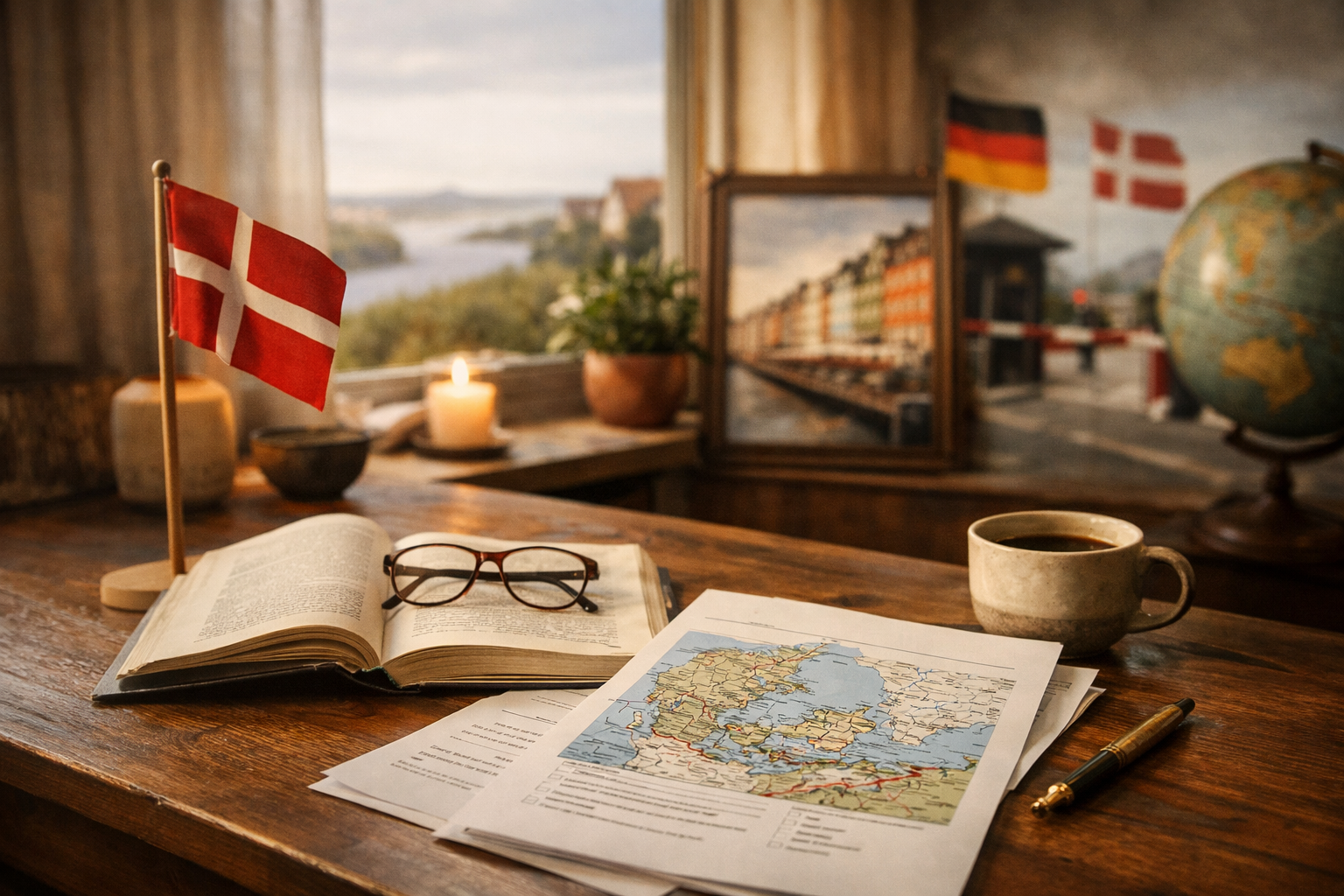
Denmark and the Schleswig Question: Border History Explained
Discover the fascinating history of Denmark's Schleswig border, from medieval times to modern day. Learn how this territorial dispute shaped Danish identity and what you need to know for the citizenship exam.

Introduction
The Schleswig question stands as one of the most defining moments in Danish history, fundamentally shaping the nation's borders, national identity, and political consciousness. If you're preparing for the Danish citizenship test, understanding this complex historical narrative is essential—not only for passing the exam, but for genuinely comprehending what it means to be Danish.
The dispute over Schleswig wasn't merely a territorial squabble between Denmark and Germany. It represented a clash of cultures, languages, and nationalisms that echoed throughout 19th-century Europe. For centuries, the Duchy of Schleswig existed in a peculiar political limbo, creating ongoing tension that would eventually result in wars, referendums, and the redrawing of Scandinavia's map.
In this guide, we'll explore the historical roots of this conflict, the wars that ensued, and how it was ultimately resolved. Whether you're using Danify to prepare for your citizenship exam or simply interested in Danish history, this deep dive will provide the context you need.
## Medieval Beginnings and the Personal Union
The Duchy System
To understand the Schleswig question, we must first grasp the unique political structure of medieval and early modern Scandinavia. Schleswig was a duchy—a territory ruled by a duke—but it wasn't straightforward. From 1386 onwards, the rulers of Denmark and Schleswig were often the same person, creating a complex personal union rather than a formal merger.
Key points about this period:
- Schleswig maintained its own distinct identity, laws, and governance structure
- The territory was located on the Jutland Peninsula, south of modern-day Denmark
- It had a mixed population: Danish-speaking inhabitants in the north and German-speaking populations in the south
- Holstein, an adjacent territory, was more firmly integrated with the Holy Roman Empire
The Language Divide
One of the most crucial aspects of the Schleswig question was the language divide. Northern Schleswig was predominantly Danish-speaking, while southern Schleswig had a German-speaking majority. This linguistic boundary would eventually become the focal point of nationalist movements in the 19th century, making language one of the most important markers of national identity in the region.
## The Wars and the Crisis (1848-1920)
The First Schleswig War (1848-1851)
The First Schleswig War erupted during the broader wave of European revolutions in 1848. The immediate cause was the attempt by the Danish Crown to integrate Schleswig more directly into the Danish state. German nationalists and Holstein's population, which was more culturally German, fiercely opposed this move.
What you should know for the citizenship exam:
- Denmark initially seemed victorious but eventually accepted a compromise
- The war demonstrated the growing power of German nationalism
- International powers, particularly Britain and Russia, intervened diplomatically
- The conflict ended without a definitive territorial settlement
The Second Schleswig War (1864)
The Second Schleswig War proved far more consequential. Tensions reignited over succession rights and constitutional issues. This time, Denmark faced a coalition of German states led by Prussia, a vastly more powerful military force.
The outcome was devastating for Denmark:
- Denmark lost the war militarily and territorially
- Through the Treaty of Vienna (1864), Denmark ceded both Schleswig and Holstein to Prussia
- Denmark lost approximately 40% of its territory and 30% of its population
- This represented the most traumatic moment in Danish national consciousness
This defeat became known in Danish as "Krigen 1864" (The War of 1864), and it remains a pivotal moment in Danish collective memory. Many Danes today can still feel the emotional resonance of this historical loss.
The Road to the 1920 Referendum
After Prussia's victory, Germany controlled both Schleswig and Holstein. However, the question of Schleswig wasn't closed. Following Germany's defeat in World War I, the international community recognized that populations should determine their own political futures—the principle of self-determination.
The Treaty of Versailles (1919) provided for a referendum in Schleswig to determine whether the territory would return to Denmark or remain with Germany. This was revolutionary for its time, representing one of the first applications of democratic self-determination in European territorial disputes.
## The 1920 Referendum and Modern Borders
How the Referendum Worked
The 1920 referendum was divided into two zones, reflecting the linguistic and cultural divisions:
- Zone I (Northern Schleswig): Predominantly Danish-speaking. Voted approximately 75% in favor of union with Denmark
- Zone II (Central Schleswig): More mixed population. Voted approximately 80% in favor of remaining with Germany
The result was a partition of Schleswig along the Kongeåen River, which today marks the Denmark-Germany border. Northern Schleswig returned to Danish control, while the southern portion remained German (now part of the state of Schleswig-Holstein).
Why This Matters for Citizenship Knowledge
When preparing with resources like Danify, remember these key facts:
- The 1920 border settlement established present-day Denmark's southern border
- This peaceful, democratic resolution became a model for international disputes
- The referendum demonstrated respect for minority rights and self-determination
- Modern North Schleswig (Sønderjylland) remains part of Denmark today
## Legacy and Contemporary Significance
Danish-German Relations Today
Remarkably, the Schleswig question transformed from a source of bitter conflict to a model of peaceful coexistence. Modern Denmark and Germany maintain excellent relations, and the border region has become a zone of cooperation rather than contention.
The German minority in North Schleswig (approximately 15,000-20,000 people) continues to live peacefully within Denmark, with their language and culture protected. Similarly, Danish minorities exist in southern Schleswig within Germany.
Cultural Memory
The Schleswig question remains embedded in Danish consciousness. It shaped:
- Danish national identity and the importance of democracy
- The principle that borders should reflect popular will
- A commitment to minority rights and cultural pluralism
- Denmark's cautious approach to military matters and international engagement
## Conclusion
The Schleswig question represents far more than a historical border dispute. It's a story of national identity, democratic principles, and peaceful conflict resolution. From medieval personal unions through devastating wars to democratic referendums, this narrative illuminates core values that remain central to Danish society today.
For those preparing for the Danish citizenship test, understanding Schleswig history provides insight into why Danes value democracy, minority protection, and peaceful coexistence. It explains why the Common Declaration of 1955 between Denmark and Germany regarding minority rights remains so significant.
If you're studying Danish history comprehensively, consider using Danify to access structured study materials on this and other crucial topics. The citizenship exam will likely include questions about Danish borders and national history—and now you have a thorough foundation.
Ready to deepen your Danish knowledge? Start preparing for your citizenship exam today with comprehensive study tools and historical context that goes beyond simple facts.
Sources & AI note
This article was generated by AI using the sources listed here. Please verify important details in the original sources.
Official Danish Ministry of Foreign Affairs resource explaining the historical declaration protecting minority rights between Denmark and Germany, directly relevant to post-Schleswig settlement.
https://um.dk/en/about-denmark/history-and-culture/
Official Denmark.dk government portal providing comprehensive overview of Danish territorial history, borders, and the Schleswig question within national context.
https://denmark.dk/about-denmark/history
Authoritative encyclopedic source documenting the 1920 referendum process, voting results by zone, and the establishment of present-day Denmark-Germany border.
https://www.britannica.com/place/Schleswig
Official regional source for North Schleswig/Sønderjylland, containing historical information about the territory's return to Denmark and contemporary minority populations.
https://www.sonderjylland.dk/en/
Official Danish immigration portal outlining citizenship exam content requirements, including historical knowledge about Danish borders and national development.
https://nyidanmark.dk/en/coming-to-denmark/danish-citizenship/
Get study tips in your inbox
Exam guides, study strategies, and insider tips for both Danish exams, delivered for free.
Study smarter
Ready to pass your Danish exam?
Danify gives you practice questions, AI-powered hints, and progress tracking, everything you need to prepare with confidence.